General Description
The TNFs (Etanercept, Enbrel) are members of a family ofcytokines that are produced primarily in the innate immunesystem by activated mononuclear phagocytes. Etanercept is a dimeric fusion protein consisting of the extracellularligand-binding portion of the human 75-kDa (p75)TNF receptor (TNFR) linked to the Fc portion of human isotypeIgG1. The Fc component of etanercept contains the CH2domain, the CH3 domain, and the hinge region, but not theCH1 domain of IgG1. These regions are responsible for thebiological effects of immunoglobulins. Each etanerceptmolecule binds specifically to two TNF molecules in the synovialfluid of rheumatoid arthritis patients. It is equally efficaciousat blocking TNFα and TNFβ. The drug is indicatedfor reducing signs and symptoms and inhibiting the progressionof structural damage in patients with moderately toseverely active rheumatoid arthritis. Etanercept is also indicatedfor reducing signs and symptoms of moderately toseverely active polyarticular-course juvenile rheumatoidarthritis in patients 4 years of age and older who have had aninadequate response to one or more disease-modifying antirheumaticdrugs (DMARDS). Etanercept is also indicatedfor reducing signs and symptoms of active arthritis in patientswith psoriatic arthritis.
Structure and conformation
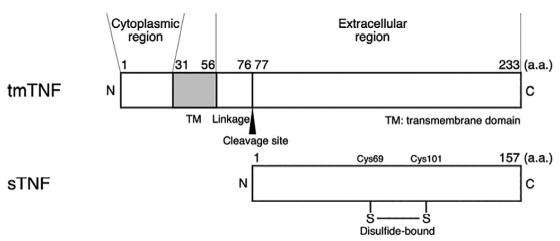
TNF exists in two forms: a type II transmembrane protein (tmTNF) and a mature soluble protein (sTNF) . The TNF protein is first produced as tmTNF on
the cell surface. tmTNF is enzymatically cleaved at its
Ala76-Val77 site by TACE and is released as sTNF. sTNF forms a noncovalently bound homotrimer that is
at least eight-fold more active than the monomer. The
TNF monomer has 10 antiparallel β-sheets and exhibits
a “jelly-roll” topology. Individual subunits form the
trimer by an edge-to-face interaction of β-sheets. sTNF
contains one disulfide bond (Cys69-Cys101), which plays
a role in its biological functions.