|
|
| | Paraquat methosulfate Basic information |
| Product Name: | Paraquat methosulfate | | Synonyms: | PARAQUAT-DIMETHYLSULFATE;1,1-dimethyl-4,4-dipyridinium bis(methylsulfate);Dextrone-X(ICI);Gramoone;Weedol(Chevron);Paraquat bis(methyl sulfate).;PARAQUATBIS;1,1'-Dimethyl-4,4'-bipyridinium dimethosulfate | | CAS: | 2074-50-2 | | MF: | C13H17N2O4S+ | | MW: | 297.35 | | EINECS: | 218-196-3 | | Product Categories: | | | Mol File: | 2074-50-2.mol | 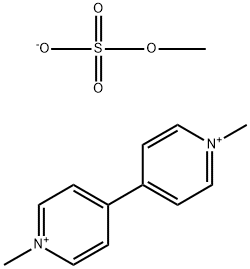 |
| | Paraquat methosulfate Chemical Properties |
| RIDADR | 2781 | | HazardClass | 6.1(a) | | PackingGroup | II | | Toxicity | LD50 orally in male rats: 100 mg/kg (Kimbrough, Gaines) |
| | Paraquat methosulfate Usage And Synthesis |
| Chemical Properties | Paraquat is a yellow solid with a faint,
ammonia-like odor. | | Uses | Herbicide. Dichloride as biological oxidation-reduction indicator. | | Production Methods | Paraquat dimethylsulphate is not produced through an independent synthetic pathway; it is simply a counter-ion variant of technical paraquat, created by converting the paraquat dication into its dimethyl sulphate salt. Commercial manufacturers first prepare paraquat using the standard bipyridyl coupling and quaternisation process, which yields the paraquat dication as the common intermediate for all paraquat salts. This technical paraquat is then reacted with dimethyl sulphate under controlled conditions to form the paraquat–dimethyl sulphate ion pair, producing a dense, crystalline salt. | | General Description | White crystalline solid or yellow solid. Used as a contact herbicide and desiccant. | | Reactivity Profile | When Paraquat methosulfate is heated to decomposition, Paraquat methosulfate emits very toxic fumes of sulfur oxides and nitrogen oxides. Avoid strong oxidizers. [EPA, 1998]. | | Health Hazard | Paraquat methosulfate can cause death by shock and/or pulmonary damage. The fatal dose is estimated to be 6 grams of paraquat ion. Exposure may cause renal tubular damage and liver dysfunction. | | Fire Hazard | When heated to decomposition, Paraquat methosulfate emits very toxic fumes of sulfur oxides and nitrogen oxides. Avoid strong oxidizers. | | Contact allergens | Paraquat is a quaternary ammonium compound with herbicide
properties, as diquat. It is contained in Cekuquat or
Dipril. It can cause contact and phototoxic contact dermatitis,
acne, and leukoderma mainly in agricultural workers. | | Mechanism of action | Broad-spectrum, non-residual activity with contact and some desiccant action. Photosystem I (electron transport) inhibitor. | | Safety Profile | Poison by ingestion and intraperitoneal routes. An herbicide. When heated to decomposition it emits very toxic fumes of SOx and NOx. | | Potential Exposure | Those engaged in manufacture,
formulation and application of this herbicide. Classified
for restricted use: limited to use by a certified applicator, or
those under applicator’s direct supervision. | | Shipping | UN2781 Bipyridilium pesticide, solid, toxic,
Hazard Class: 6.1; Labels: 6.1-Poisonous materials. | | Incompatibilities | Incompatible with oxidizers (chlorates,
nitrates, peroxides, permanganates, perchlorates, chlorine,
bromine, fluorine, etc.); contact may cause fires or explosions.
Keep away from alkaline materials, strong bases,
strong acids, oxoacids, epoxides (hydrolysis), alkylarylsulfonate
wetting agents. Corrosive to metals. Decomposes
in presence of ultraviolet (UV) light. Decomposes in heat
(see physical properties, above) and in the presence of UV
light, producing nitrogen oxides, hydrogen chloride. | | Waste Disposal | Paraquat is rapidly inactivated
in soil. It is also inactivated by anionic surfactants.
Therefore an effective and environmentally safe disposal
method would be to mix the product with ordinary household
detergent and bury the mixture in clay soil. In
accordance with 40CFR165, follow recommendations for
the disposal of pesticides and pesticide containers. Must be
disposed properly by following package label directions or
by contacting your local or federal environmental control
agency, or by contacting your regional EPA office. Consult
with environmental regulatory agencies for guidance on
acceptable disposal practices. Generators of waste containing
this contaminant (≥100 kg/mo) must conform with
EPA regulations governing storage, transportation, treatment,
and waste disposal. | | Pesticide Type | Herbicide |
| | Paraquat methosulfate Preparation Products And Raw materials |
|