


N,N-디메틸하이드라진
|
|
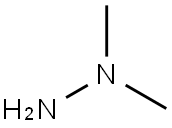
N,N-디메틸하이드라진 속성
- 녹는점
- -57.2 °C
- 끓는 점
- 60-62 °C(lit.)
- 밀도
- 0.79 g/mL at 20 °C(lit.)
- 증기 밀도
- 1.94 (vs air)
- 증기압
- 103 mm Hg ( 20 °C)
- 굴절률
- n
20/D 1.4075(lit.)
- 인화점
- 34 °F
- 저장 조건
- 2-8°C
- 용해도
- Miscible with alcohol, N,N-dimethylformamide, ether, hydrocarbons (Windholz et al., 1983), and many other polar solvents.
- 산도 계수 (pKa)
- 8.19±0.18(Predicted)
- 물리적 상태
- 무색의 액체
- 폭발한계
- 95%
- 수용성
- 혼용 가능
- 비열
- Cp(liquid): 2.73 J/(g·K), at 25℃
- 감도
- Hygroscopic
- Merck
- 14,3247
- BRN
- 605261
- Henry's Law Constant
- 2.45(x 10-9 atmm3/mol) at 25 °C (quoted, Mercer et al., 1990)
- 노출 한도
- ACGIH:TLV-TWA 0.01 ppm (0.025 mg/m3)
OSHA:PEL-TWA 0.5 ppm (1 mg/m3)
NIOSH:REL-Ceiling 0.06 ppm [2-hr]
- CAS 데이터베이스
- 57-14-7(CAS DataBase Reference)
- IARC
- 2B (Vol. 4, Sup 7, 71) 1999
안전
- 위험 및 안전 성명
- 위험 및 사전주의 사항 (GHS)
| 위험품 표기 | F,T,N | ||
|---|---|---|---|
| 위험 카페고리 넘버 | 45-11-23/25-34-51/53-37-23/24/25 | ||
| 안전지침서 | 53-45-61-36/37 | ||
| OEL | Ceiling: 0.06 ppm (0.15 mg/m3) [2-hr] | ||
| 유엔번호(UN No.) | UN 1163 | ||
| WGK 독일 | 3 | ||
| RTECS 번호 | MV2450000 | ||
| 자연 발화 온도 | 478 °F | ||
| TSCA | TSCA listed | ||
| 위험 등급 | 6.1 | ||
| 포장분류 | I | ||
| HS 번호 | 29280090 | ||
| 스토리지 클래스 | 3 - Flammable liquids | ||
| Hazard Classifications | Acute Tox. 3 Dermal Acute Tox. 3 Inhalation Acute Tox. 3 Oral Aquatic Chronic 2 Carc. 1B Eye Dam. 1 Flam. Liq. 2 Skin Corr. 1B STOT SE 3 |
||
| 유해 물질 데이터 | 57-14-7(Hazardous Substances Data) | ||
| 독성 | Acute oral LD50 for rats 122 mg/kg, mice 265 mg/kg (quoted, RTECS, 1985). | ||
| IDLA | 15 ppm | ||
| 기존화학 물질 | KE-11491 |


N,N-디메틸하이드라진 C화학적 특성, 용도, 생산
화학적 성질
1,1-Dimethylhydrazine is a colorless, flammable, hygroscopic liquid that gradually turns yellow on contact with air and is miscible with water. 1,1-Dimethylhydrazine is primar- ily used as a high-energy fuel in military applications, as a rocket propellant and fuel for thrusters, and small electrical power-generating units. 1,1-Dimethylhydrazine is also used in the manufacture of a plant growth regulator, in chemical synthesis, in photographic chemicals, as a stabilizer for fuel additives, and as an absorbent for acid gases. Exposure to 1,1-dimethylhydrazine usually occurs at the workplace during use and handling of the chemical substance. No information is available on the carcinogenic effects of 1,1-dimethylhydrazine in humans. Carcinogenic effects were observed in mice and rats exposed to 1,1-dimethylhydrazine by inhalation, but the carcinogenicity could not be defi nitively attributed to 1,1-dimethylhydrazine because of the presence of contaminants in the study. The US EPA has not classifi ed 1,1-dimethylhydrazine for potential carcinogenicity, while the IARC has classifi ed 1,1-dimethylhydrazine as Group 2B, meaning a possible human carcinogen.물리적 성질
Clear, colorless fuming liquid with an amine-like odor. Turns yellow on exposure to air. Odor detection threshold concentrations ranged from 6.1 to 14 ppmv (Jacobson et al., 1955).용도
1,1-Dimethylhydrazine is used in rocket fuel.정의
ChEBI: A member of the class of hydrazines that is hydrazine substituted by two methyl groups at position 1.일반 설명
A clear colorless liquid with an ammonia-like odor. Flash point 0°F. Corrosive to the skin. Less dense than water and soluble in water. Vapors are heavier than air and very toxic by inhalation, attacking the eyes and respiratory system. Prolonged exposure of containers to heat may result in their violent rupturing and rocketing due to decomposition. Generates toxic oxides of nitrogen when burned. Vapors may travel to a source of ignition and a flame can flashback to the source of vapors. Used as a rocket propellant and to make other chemicals.공기와 물의 반응
Highly flammable over a wide range of vapor concentrations. May ignite spontaneously when spread on a large surface exposed to the air. [Def. Res. and Eng., pp 299-300(1963)]. Dissolves and slowly decomposes in water.반응 프로필
1,1-Dimethylhydrazine is a powerful reducing agent. Ignition can occur on contact with oxidizing agents such hydrogen peroxide and fuming nitric acid, [Haz. Chem. Data(1966)]. Also reacts as a base to neutralize acids in exothermic reactions.건강위험
1,1-Dimethylhydrazine exhibits high acute toxicity as a result of exposure by all routes. Death or permanent injury may result after very short exposure to small quantities. Chronic exposure may cause pneumonia, liver damage, and kidney damage.화재위험
Vapor may explode if ignited in an enclosed area. Vapors may travel to a source of ignition and flashback. Runoff to sewer may create fire or explosion hazard. When 1,1-Dimethylhydrazine decomposes, 1,1-Dimethylhydrazine gives off toxic nitrogen compound fumes. Dissolves, swells, and disintegrates many plastics. Dangerous when exposed to heat, flame, or oxidizers. Hazardous polymerization may not occur.Safety Profile
Confirmed carcinogen with experimental carcinogenic, tumorigenic, and teratogenic data. Other experimental reproductive effects. Poison byingestion, intraperitoneal, intravenous, and intracerebral routes. Moderately toxic by inhalation and skin contact. Human mutation data reported. A plant growth control agent. Corrosive. A powerful reducing agent. A dangerous fire hazard. It is hypergolic with many oxidants (e.g., dinitrogen tetroxide, hydrogen peroxide, and nitric acid). Dangerous when exposed to heat, flame, or oxidizers; can react vigorously with oxidning materials such as air, fuming HNO3, (HNO3 + N2O4), NO. A high-energy propellant for liquid-fueled rockets. To fight fire, use alcohol foam, CO2, dry chemical. When heated to decomposition it emits highly toxic fumes of NOx. See also HYDRAZINE.Carcinogenicity
1,1-Dimethylhydrazine is reasonably anticipated to be a human carcinogen based on sufficient evidence of carcinogenicity from studies in experimental animals.환경귀착
Chemical/Physical. Releases toxic nitrogen oxides when heated to decomposition (Sax and Lewis, 1987). Ignites spontaneously in air or in contact with hydrogen peroxide, nitric acid, or other oxidizers (Patnaik, 1992).N-Nitrosodimethylamine was the major product of ozonation of 1,1-dimethylhydrazine in the dark. Hydrogen peroxide, methyl hydroperoxide, and methyl diazene were also identified (HSDB, 1989).
Purification Methods
Fractionally distil the hydrazine through a 4-ft column packed with glass helices. Precipitate it as its oxalate from diethyl ether solution. After crystallising from 95% EtOH, the salt is decomposed with aqueous saturated NaOH, and the free base is distilled, dried over BaO and redistilled [McBride & Kruse J Am Chem Soc 79 572 1957]. Distillation and storage should be under nitrogen. [Beilstein 4 IV 3322.]N,N-디메틸하이드라진 준비 용품 및 원자재
원자재
준비 용품
N,N-디메틸하이드라진 공급 업체
글로벌( 0)공급 업체
| 공급자 | 전화 | 이메일 | 국가 | 제품 수 | 이점 |
|---|