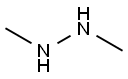
디메틸 히드라진 C화학적 특성, 용도, 생산
화학적 성질
colourless or yellow hygroscopic liquid which fumes in air
용도
1,2-Dimethylhydrazine (SDMH) unlike its analog 1,1-
dimethylhydrazine (UDMH) is used only in small quantities
as a research chemical. There are no known commercial uses,
although it was evaluated as a high-energy rocket fuel. The
material is a fuming, strongly alkaline, moderately volatile
liquid.
제조 방법
다이벤조일하이드라진으로부터 제조. 나이트로메탄으로부터 전기합성됨
1,2-다이메틸하이드라진 과 같은 대칭을 이루는 다이알킬하이드라진은 (1)리늄 알루미늄 수소화물을 이용하여 해당되는 아진의 환원에 의해 제조됨, (2)알킬 치환 다이아자사이클로프로판(diazacyclopropane)을 가수분해하여 제조함 또는, (3)알킬 할로겐화물과 하이드라진의 반응에 의해 만들어짐
하이드라진은 쉽게 메틸화 됨. Symmetrical dimethylhydrazine의 합성에는 다이아실 화합물을 매개하는 간접경로가 주로 이용됨
정의
ChEBI: A member of the class of hydrazines that is hydrazine in which one of the hydrogens attached to each nitrogen is replaced by a methyl group. A powerful DNA alkylating agent and carcinogen, it is used to induce colon cancer in laboratory rats and mice.
일반 설명
A colorless liquid with an ammonia-like odor. Less dense than water. Flash point is 5°F. Contact irritate skin, eyes, and mucous membranes. Very toxic by ingestion, inhalation and skin absorption. Used to make photographic chemicals.
공기와 물의 반응
Highly flammable. Fumes upon exposure to air . Soluble in water with evolution of heat.
반응 프로필
1,2-Dimethyl hydrazine dissolves, swells, and disintegrates many plastics [USCG, 1999].
건강위험
Breathing of vapor causes pulmonary irritation, delayed gastro-intestinal irritation, tremors, and convulsions. Contact with skin or mucous membranes causes chemical burns. Can be absorbed through skin to cause systemic intoxication and convulsions.
Safety Profile
Confirmed carcinogen
with experimental carcinogenic,
neoplastigenic, tumorigenic, and teratogenic
data. Poison by ingestion, intraperitoneal,
intravenous, subcutaneous, and
intramuscular routes. Moderately toxic by
inhalation. Human mutation data reported.
A very dangerous fire hazard when exposedto heat, flame, or oxidizers. A hgh-energy
propellant for liquid-fueled rockets. When
heated to decomposition it emits toxic
fumes of NOx
Carcinogenicity
SDMH is carcinogenic to mice,
rats, and hamsters using a variety of exposure routes. Oral
doses of 21 mg/kg for 11 weeks produced intestinal tumors
in rats. A lower dose (3 mg/kg) in drinking water for
12 months produced liver hemangioendotheliomas.A
number of these tumors were metastatic. Mice given
doses of 60–90 mg/day in drinking water developed a variety
of tumors including angiosarcomas and lung adenomas
. Both oral administration and intraperitoneal
injection increased lung adenomas in the A/J strain
mouse. Hamsters also developed angiosarcomas,
intestinal tumors, and liver tumors following average daily
intakes of 160 mg in drinking water. An in-depth
description of the uniqueness of the colonic tumors was
presented.
디메틸 히드라진 준비 용품 및 원자재
원자재
준비 용품