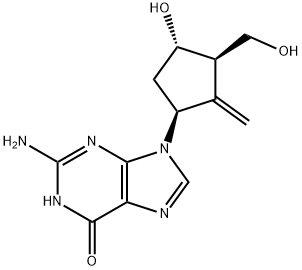
Entecavir is a cyclopentyl guanosine analog launched for the once-daily oral treatment of chronic hepatitis B virus (HBV) infection, and it is the third nucleoside or nucleotide analog to be marketed for this indication. Lamivudine, a deoxythiacytosine analog, and adefovir dipivoxil, a nucleotide analog, have been marketed since 1998 and 2002, respectively. Entecavir and adefovir are specifically indicated for HBV, whereas lamivudine is indicated for both HBV and HIV infections.
화학적 성질
White to Off-White/Yellow Crystalline Powder
정의
ChEBI: Guanine substituted at the 9 position by a 4-hydroxy-3-(hydroxymethyl)-2-methylidenecyclopentyl group. A synthetic analogue of 2'-deoxyguanosine, it is a nucleoside reverse transcriptase inhibitor with selective antiviral activity against hepatitis B virus
Entecavir is phosphorylated intracellularly to the active triphosphate form, which competes with deoxyguanosine triphosphate, the natural substrate of hepatitis B virus reverse transcriptase, inhibiting every stage of the enzyme's activity, although it ha
no activity against HIV. It is used for the treatment of chronic hepatitis B.
상품명
Baraclude (BMS)
Clinical Use
Treatment of chronic hepatitis B virus infection in patients >16 years of age. Entecavir comes as a tablet and solution (liquid) to take by mouth. It is usually taken once a day on an empty stomach, at least 2 hours after a meal and at least 2 hours before the next meal. Take entecavir at around the same time every day.
Research
In a retrospective cohort study that includes 182 patients with chronic hepatitis B[1], Entecavir (ETV) demonstrated significant advantages in terms of both efficacy and cost-effectiveness compared to tenofovir amibufenamide (TMF), with better clinical outcomes and higher economic value. These results suggest that ETV may be considered a potentially preferred antiviral regimen for patients with CHB.