


메틸렌블루
|
|
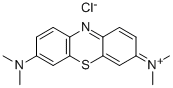
메틸렌블루 속성
- 녹는점
- 190 °C (dec.)(lit.)
- 밀도
- 1.0 g/mL at 20 °C
- 굴절률
- n20/D1.347
- 인화점
- 45 °C
- 저장 조건
- room temp
- 용해도
- 물, 에탄올, 에틸렌 글리콜, 메틸 셀로솔브에 용해됨
- 물리적 상태
- 액체
- 산도 계수 (pKa)
- 2.6, 11.2(at 25℃)
- 색상 색인 번호
- 52015
- 색상
- 녹색
- Specific Gravity
- 0.98
- 냄새
- 냄새 없는
- 수용성
- 40g/L(20℃)
- 최대 파장(λmax)
- 661 nm
- ex/em
- λex 665 nm; λem 692 nm
- Merck
- 14,6060
- BRN
- 3641570
- 생물학 분야의 응용
- Detecting microorganisms; treating diabetic retinopathy,macular degeneration,malignant uveal melanomas,erysipelas,hidradenitis suppurativa,inflammation,skin diseases
- 주요 응용
- 미생물학
- 화장품 원료 기능
- 머리 염색
- InChI
- 1S/C16H18N3S.ClH/c1-18(2)11-5-7-13-15(9-11)20-16-10-12(19(3)4)6-8-14(16)17-13;/h5-10H,1-4H3;1H/q+1;/p-1
- InChIKey
- CXKWCBBOMKCUKX-UHFFFAOYSA-M
- SMILES
- [Cl-].CN(C)c1ccc2N=C3C=C\C(C=C3Sc2c1)=[N+](/C)C
안전
- 위험 및 안전 성명
- 위험 및 사전주의 사항 (GHS)
| 위험품 표기 | Xn | ||
|---|---|---|---|
| 위험 카페고리 넘버 | 10-41-22-20/21/22-36/37/38 | ||
| 안전지침서 | 26-39-36 | ||
| 유엔번호(UN No.) | UN 1993 3/PG 3 | ||
| WGK 독일 | 3 | ||
| RTECS 번호 | SP5740000 | ||
| TSCA | TSCA listed | ||
| HS 번호 | 32049010 | ||
| 스토리지 클래스 | 12 - Non Combustible Liquids | ||
| 유해 물질 데이터 | 61-73-4(Hazardous Substances Data) | ||
| 독성 | LD50 oral in rat: 1180mg/kg | ||
| 기존화학 물질 | KE-06942 |

메틸렌블루 C화학적 특성, 용도, 생산
개요
메틸렌 블루(Methylene blue)는 헤테로 고리 방향족 화합물이다. 상온에서 짙푸른 녹색을 띄며, 산화 시 푸른색, 환원 시 무색을 띄는 특징이 있다. 이 특성 때문에 산화 환원의 지표로 사용된다. 수화물은 파란색이며, 메틸렌 블루 1분자당 물 분자가 3분자 결합한 형태로 존재한다.100~110도에서 분해되며 동물 세포의 염색에도 널리 사용한다. 독일의 과학자 하인리히 카로에 의해 1876년 처음으로 합성되었다.용도
메틸렌 블루는 비뇨기 진통제로 널리 사용되며 그 외에도 다양한 용도로 사용된다.화학적 성질
Methylene blue is a heterocyclic aromatic chemical compound with the molecular formula C16H18N3SCl. It has many uses in a range of different fields, such as biology and chemistry. At room temperature it appears as a solid, odorless, dark green powder, that yields a blue solution when dissolved in water. The hydrated form has 3 molecules of water per molecule of methylene blue. Methylene blue should not be confused with methyl blue, another histology stain, new methylene blue, nor with the methyl violets often used as pH indicators.용도
Methylene Blue, 1% w/v aqueous solution is used as a dye in different staining procedures viz. Wright's stain and Jenner's stain. It also serves as an indicator and medicine. Further, it is used to examine RNA and DNA under the microscope or in a gel. It is widely used as a redox indicator in analytical chemistry. It is also used in the sulfide analysis.정의
ChEBI: An organic chloride salt having 3,7-bis(dimethylamino)phenothiazin-5-ium as the counterion. A commonly used dye that also exhibits antioxidant, antimalarial, antidepressant and cardioprotective properties.일반 설명
Methylene blue, also known as methylthioninium chloride, is a photoactive phenothiazine dye. It is a small molecular weight dye, which is effective against Gram positive and Gram negative bacteria.위험도
Toxic by ingestion.생물학적 활성
Biological stain and redox indicator. Inhibits tau filament formation (IC 50 = 1.9 μ M). Also inhibits soluble guanylyl cyclase.Clinical Use
Methylene blue is 3,7-bis(dimethylamino)-phenazathioniumchloride (Urised). The compound occurs as a dark greencrystalline powder with a metallic appearance that is solublein water (1:25) and alcohol (1:65).Methylene blue has weak antiseptic properties that makeit useful for the treatment of cystitis and urethritis. The actionof methylene blue is considered to be bacteriostatic.The compound colors the urine and stool blue green.
Safety Profile
Poison by ingestion,intraperitoneal, intravenous, and subcutaneous routes.Human systemic effects: cyanosis, blood changes.Experimental reproductive effects. Mutation datareported. When heated to decomposition it emits verytoxic fumes of NOx, SOx, andStaining Procedures
The procedure includes following steps:1. Get methyelene blue (1% in aqueous solution).
2. Mounting the sample on a glass slide (either dried or fixed using methanol);Flood the sample with Methylene Blue.
3. Wait for 1-3 minutes.
4. Wash under tap water. Blot dry with tissue paper. Add cover slip (as desired).
5. Observe under a microscope.
Purification Methods
Crystallise the chloride from 0.1M 664 2HCl (16mL/g), the crystals are separated by centrifugation, washed with chilled EtOH and diethyl ether, and dried under vacuum. Crystallise it from 50% aqueous EtOH, wash it with absolute EtOH, and dry it at 50-55o for 24hours. It has also been crystallised from *benzene/MeOH (3:1). It has been salted out with NaCl from a commercial concentrated aqueous solution, then crystallised from water, and dried at 100o in an oven for 8-10hours. [Beilstein 27 III/IV 5152.]메틸렌블루 준비 용품 및 원자재
원자재
준비 용품
메틸렌블루 공급 업체
글로벌( 491)공급 업체
| 공급자 | 전화 | 이메일 | 국가 | 제품 수 | 이점 |
|---|---|---|---|---|---|
| Shenyang Delier Biotechnology Co., Ltd. | 15942301471 15942301471 |
15942301471@163.cn | China | 114 | 58 |
| Guangzhou Viocon Pharmaceutical Technology Co., Ltd | +86-13424074264; 13726739909 |
chenhuini@cti-cert.com | China | 497 | 58 |
| Shenyang yimoke chemical products co. LTD | 13998106873 |
297303255@qq.com | China | 150 | 58 |
| Kaiyuan city Shenxin fine chemical co., ltd. | 024-22595298 18698863499 |
1253960@qq.com | China | 165 | 58 |
| PURE SYNMR INGREDIENTS LIMITED | 021-26015538 13381836003 |
sven_shi@puresynmr.com | China | 32 | 50 |
| Shenyang Snota Biotech Co.,Ltd | +86-024-31174117 18002429090 |
2193387905@qq.com | China | 104 | 58 |
| J & K SCIENTIFIC LTD. | 18210857532 18210857532 |
jkinfo@jkchemical.com | China | 96815 | 76 |
| Meryer (Shanghai) Chemical Technology Co., Ltd. | 4006356688 18621169109 |
market03@meryer.com | China | 40202 | 62 |
| 3B Pharmachem (Wuhan) International Co.,Ltd. | 18930552037 |
3bsc@sina.com | China | 15813 | 69 |
| TCI (Shanghai) Development Co., Ltd. | 021-67121386 |
Sales-CN@TCIchemicals.com | China | 24512 | 81 |