


카르무스틴
|
|
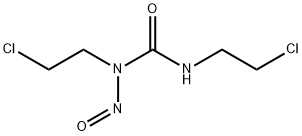
카르무스틴 속성
- 녹는점
- 30 °C (lit.)
- 밀도
- 1.6948 (rough estimate)
- 굴절률
- 1.6100 (estimate)
- 저장 조건
- -20°C
- 용해도
- insoluble in H2O; ≥21.51 mg/mL in DMSO; ≥27.15 mg/mL in EtOH
- 물리적 상태
- (유성 액체에서 무정형 고체로)
- 산도 계수 (pKa)
- 10.19±0.46(Predicted)
- 색상
- 담황색 분말
- 수용성
- 18°C에서 <0.1g/100mL
- Merck
- 14,1845
- Henry's Law Constant
- 2.1×10⁵ mol/(m3Pa) at 25℃, HSDB (2015)
- 안정성
- 온도에 민감함
- InChI
- 1S/C5H9Cl2N3O2/c6-1-3-8-5(11)10(9-12)4-2-7/h1-4H2,(H,8,11)
- InChIKey
- DLGOEMSEDOSKAD-UHFFFAOYSA-N
- SMILES
- ClCCNC(=O)N(CCCl)N=O
- CAS 데이터베이스
- 154-93-8(CAS DataBase Reference)
- IARC
- 2A (Vol. 26, Sup 7) 1987
안전
- 위험 및 안전 성명
- 위험 및 사전주의 사항 (GHS)
| 위험품 표기 | T+ | ||
|---|---|---|---|
| 위험 카페고리 넘버 | 45-46-60-61-28 | ||
| 안전지침서 | 53-22-36/37/39-45 | ||
| 유엔번호(UN No.) | 3249 | ||
| WGK 독일 | 3 | ||
| RTECS 번호 | YS2625000 | ||
| 위험 등급 | 6.1(a) | ||
| 포장분류 | II | ||
| HS 번호 | 29241990 | ||
| 스토리지 클래스 | 6.1A - Combustible acute toxic Cat. 1 and 2 very toxic hazardous materials |
||
| Hazard Classifications | Acute Tox. 2 Oral Carc. 1B Repr. 1B |
||
| 유해 물질 데이터 | 154-93-8(Hazardous Substances Data) | ||
| 독성 | LD50 in mice (mg/kg): 19-25 orally, 26 i.p., 24 s.c.; in rats (mg/kg): 30-34 orally (Thompson, Larson) | ||
| 중점관리물질 필터링 | 별표2-45 |


카르무스틴 C화학적 특성, 용도, 생산
개요
Carmustine is a nitrogen mustard β-chloro-nitrosourea compound that is used as an alkylating agent. It forms interstrand crosslinks in DNA, which prevents DNA replication and transcription leading to apoptosis. Carmustine is also reported to inhibit glutathione reductase, thioredoxin reductase, and lipoamide dehydrogenase. Carmustine has been tested in clinical trials as a cytostatic agent for Hodgkin’s and non-Hodgkin’s lymphoma, myeloma, malignant melanoma, glioblastoma, and other brain tumors.화학적 성질
Carmustine is an orange-yellow crystalline solid or powder.용도
Carmustine is a nitrogen mustard β-chloro-nitrosourea compound that is used as an alkylating agent. It forms interstrand crosslinks in DNA, which prevents DNA replication and transcription leading to apoptosis. Carmustine is also reported to inhibit glutathione reductase, thioredoxin reductase, and lipoamide dehydrogenase. Carmustine has been tested in clinical trials as a cytostatic agent for Hodgkin’s and non-Hodgkin’s lymphoma, myeloma, malignant melanoma, glioblastoma, and other brain tumors.정의
ChEBI: A member of the class of N-nitrosoureas that is 1,3-bis(2-chloroethyl)urea in which one of the nitrogens is substituted by a nitroso group.일반 설명
Orange-yellow solid.공기와 물의 반응
Insoluble in water.반응 프로필
Carmustin decomposes rapidly in acid and in solutions above pH 7; most stable in petroleum ether or aqueous solution at pH 4.위험도
Extremely toxic, central nervous system depression, pulmonary fibrosis, renal and hepatic damage, cytotoxic, immunosuppressive, carcino- gen.화재위험
Flash point data for Carmustin are not available. Carmustin is probably combustible.Safety Profile
Confirmed carcinogen withexperimental carcinogenic and tumorigenic data. A humanpoison by parenteral route. An experimental poison byingestion, intravenous, intraperitoneal, parenteral, andsubcutaneous routes. Human systemic effects byparenteral, int잠재적 노출
BCNU has been used since 1971 as an antineoplastic agent in the treatment of Hodgkin’slymphoma; multiple meyloma; and primary or metastatic brain tumors. It also has been reported to have antiviral, antibacterial, and antifungal activity, but no evidence was found that it is used in these ways. BCNU is not known to be naturally occurring. Health professionals who handle this drug (for example, pharmacists, nurses, and physicians) may possibly be exposed to BCNU during drug preparation, administration, or cleanup; however, the risks can be avoided through use of containment equipment and proper work practicesCarcinogenicity
Bis(chloroethyl) nitrosourea (BCNU) is reasonably anticipated to be a human carcinogen based on sufficient evidence of carcinogenicity from studies in experimental animals.환경귀착
It is generally assumed that BCNU exerts its cytotoxicity through the liberation of alkylating and carbamoylating moieties. An alkylating entity, particularly chloroethyl carbonium ion, is strongly electrophilic and can alkylate a variety of biomolecules, including the purine and pyrimidine bases of DNA. BCNU causes DNA interstrand cross-linking, which is associated with cytotoxicity. The carbamoylation of lysine residues of protein can inactivate certain enzymes, thus interfering with DNA and RNA synthesis and repair processes. The inhibition of glutathione reductase by this carbamoylation further contributes to cytotoxicity.운송 방법
UN3249 Medicine, solid, toxic, n.o.s., Hazard Class: 6.1; Labels: 6.1-Poisonous materials. UN2811 Toxic solids, organic, n.o.s., Hazard Class: 6.1; Labels: 6.1- Poisonous materials, Technical Name Required.비 호환성
Acids and acid solutions above pH 7 cause rapid decomposition. Most stable at pH 4 in aqueous solution or petroleum ether.폐기물 처리
It is inappropriate and possibly dangerous to the environment to dispose of expired or waste pharmaceuticals by flushing them down the toilet or discarding them to the trash. Household quantities of expired or waste pharmaceuticals may be mixed with wet cat litter or coffee grounds, double-bagged in plastic, discard in trash. Larger quantities shall carefully take into consideration applicable DEA, EPA, and FDA regulations. If possible return the pharmaceutical to the manufacturer for proper disposal being careful to properly label and securely package the material. Alternatively, the waste pharmaceutical shall be labeled, securely packaged and transported by a state licensed medical waste contractor to dispose by burial in a licensed hazardous or toxic waste landfill or incinerator.카르무스틴 준비 용품 및 원자재
원자재
준비 용품
카르무스틴 공급 업체
글로벌( 387)공급 업체
| 공급자 | 전화 | 이메일 | 국가 | 제품 수 | 이점 |
|---|---|---|---|---|---|
| Changzhou green chemical co., LTD | 0519-82733646 13814799543 |
sales_01@salutchem.com | China | 108 | 58 |
| J & K SCIENTIFIC LTD. | 18210857532 18210857532 |
jkinfo@jkchemical.com | China | 96815 | 76 |
| 3B Pharmachem (Wuhan) International Co.,Ltd. | 18930552037 |
3bsc@sina.com | China | 15813 | 69 |
| Chembest Research Laboratories Limited | 021-20908456 |
sales@BioChemBest.com | China | 5996 | 61 |
| TCI (Shanghai) Development Co., Ltd. | 021-67121386 |
Sales-CN@TCIchemicals.com | China | 24512 | 81 |
| Beijing HwrkChemical Technology Co., Ltd | 89508211 18501085097 |
sales.bj@hwrkchemical.com | China | 9409 | 55 |
| Pure Chemistry Scientific Inc. | 001-857-928-2050 or 1-888-588-9418 |
sales@chemreagents.com | United States | 10174 | 62 |
| Adamas Reagent, Ltd. | 4006009262 13023226327 |
hmj@titansci.com | China | 14098 | 59 |
| LGM Pharma | 1-(800)-881-8210 |
inquiries@lgmpharma.com | United States | 2110 | 70 |
| Chemsky(shanghai)International Co.,Ltd. | 021-50135380 |
shchemsky@sina.com | China | 32273 | 50 |