


4,4'-메틸렌디아닐린
|
|
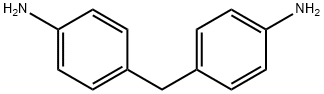
4,4'-메틸렌디아닐린 속성
- 녹는점
- 89-91 °C(lit.)
- 끓는 점
- 242 °C2 mm Hg(lit.)
- 밀도
- 1.15
- 증기압
- 0Pa at 25℃
- 굴절률
- 1.5014 (estimate)
- 인화점
- 430 °F
- 용해도
- 물에 용해
- 산도 계수 (pKa)
- 5.32±0.25(Predicted)
- 물리적 상태
- Crystal
- 색상
- 흰색에서 밝은 노란색
- 수용성
- 약간 용해됨. 19ºC에서 <0.1g/100mL
- 비열
- Cp(crystal): 1.37 J/(g·K), at 25℃
- Merck
- 14,2980
- BRN
- 474706
- Henry's Law Constant
- 1.9×10⁵ mol/(m3Pa) at 25℃, HSDB (2015)
- 노출 한도
- ACGIH: TWA 0.1 ppm (Skin)
OSHA: STEL 100 ppb
- InChI
- 1S/C13H14N2/c14-12-5-1-10(2-6-12)9-11-3-7-13(15)8-4-11/h1-8H,9,14-15H2
- InChIKey
- YBRVSVVVWCFQMG-UHFFFAOYSA-N
- SMILES
- Nc1ccc(Cc2ccc(N)cc2)cc1
- LogP
- 1.55 at 25℃
- CAS 데이터베이스
- 101-77-9(CAS DataBase Reference)
- IARC
- 2B (Vol. 39, Sup 7) 1987
안전
- 위험 및 안전 성명
- 위험 및 사전주의 사항 (GHS)
| 위험품 표기 | T,N | ||
|---|---|---|---|
| 위험 카페고리 넘버 | 45-39/23/24/25-43-48/20/21/22-51/53-68 | ||
| 안전지침서 | 53-45-61 | ||
| 유엔번호(UN No.) | UN 2651 | ||
| WGK 독일 | 3 | ||
| RTECS 번호 | BY5425000 | ||
| TSCA | TSCA listed | ||
| 위험 등급 | 6.1 | ||
| 포장분류 | III | ||
| HS 번호 | 29215900 | ||
| 스토리지 클래스 | 6.1C - Combustible acute toxic Cat.3 toxic compounds or compounds which causing chronic effects |
||
| Hazard Classifications | Acute Tox. 3 Oral Aquatic Acute 1 Aquatic Chronic 2 Carc. 1B Muta. 2 Skin Sens. 1 STOT RE 2 STOT SE 1 |
||
| 유해 물질 데이터 | 101-77-9(Hazardous Substances Data) | ||
| 독성 | LD50 oral in rabbit: 620mg/kg | ||
| 기존화학 물질 | KE-23803 | ||
| 유해화학물질 필터링 | 2014-1-699 | ||
| 중점관리물질 필터링 | 별표1-51 | ||
| 함량 및 규제정보 | 물질구분: 유독물질; 혼합물(제품)함량정보: 4,4'-메틸렌디아닐린 및 이를 0.1% 이상 함유한 혼합물 |


4,4'-메틸렌디아닐린 C화학적 특성, 용도, 생산
개요
4,4'-Methylenedianiline is an industrial chemical that is not known to occur naturally. It is also commonly known as diaminodiphenylmethane or MDA. It occurs as a colorless to pale yellow solid and has a faint odor. 4,4'-Methylenedianiline is used mainly for making polyurethane foams, which have a variety of uses, such as insulating materials in mailing containers. It is also used for making coating materials, glues, Spandex fiber, dyes, and rubber. 4,4'-Methylenedianiline is also a by-product of azo dyes. It is also possibly formed by hydrolysis of diphenylmethane-4A'-diisocyanate.화학적 성질
4,4-Diaminodiphenylmethane is a pale yellow crystalline solid (turns light brown on contact with air) with a faint amine-like odor that is unstable in the presence of light or air and emits toxic fumes of aniline and nitrogen oxides when heated to decomposition. 4,4'-Methylenedianiline is primarily used in industry as a chemical intermediate in the production of 4,4-methylenedianiline diisocyanates and polyisocyanates, but is also used as a cross-linking agent for the determination of tungsten and sulfates, and as a corrosion inhibitor. Exposure to this substance irritates the skin and eyes and causes liver damage. 4,4'-Methylenedianiline is reasonably anticipated to be a human carcinogen. (NCI05)용도
4,4'-methylenedianiline be used as organic intermediates. Mainly used for the synthesis of polyimide and as curing agent of epoxy resin.정의
ChEBI: 4,4'-Methylenedianiline is an aromatic amine that is diphenylmethane substituted at the 4-position of each benzene ring by an amino group. It is primarily used in industry as a chemical intermediate in the production of 4,4-methylenedianiline diisocyanates and polyisocyanates.일반 설명
A tan flake or lump solid with a faint fishlike odor. May be toxic by inhalation or ingestion, and may be irritating to skin. Insoluble in water.공기와 물의 반응
Oxidizes slowly in air in a reaction catalyzed by light. Somewhat hygroscopic. Insoluble in water.반응 프로필
4,4'-Methylenedianiline polymerizes if heated above 257° F. Incompatible with strong oxidizing agents. 4,4'-Methylenedianiline is also incompatible with acids. Catalyzes isocyanate-alcohol and epoxide reactions. Flammable gaseous hydrogen may be generated in combination with strong reducing agents, such as hydrides.건강위험
TOXIC; inhalation, ingestion or skin contact with material may cause severe injury or death. Contact with molten substance may cause severe burns to skin and eyes. Avoid any skin contact. Effects of contact or inhalation may be delayed. Fire may produce irritating, corrosive and/or toxic gases. Runoff from fire control or dilution water may be corrosive and/or toxic and cause pollution.화재위험
Combustible material: may burn but does not ignite readily. When heated, vapors may form explosive mixtures with air: indoors, outdoors and sewers explosion hazards. Contact with metals may evolve flammable hydrogen gas. Containers may explode when heated. Runoff may pollute waterways. Substance may be transported in a molten form.Safety Profile
Confirmed carcinogen with experimental tumorigenic data. Human poison by ingestion. Poison by subcutaneous and intraperitoneal routes. Human systemic effects by ingestion: rigidity, jaundice, other liver changes. An eye irritant. Mutation data reported. It is not rapidly absorbed through the skin. Combustible when exposed to heat or flame. When heated to decomposition it emits highly toxic fumes of aniline and NOx.잠재적 노출
Used as an intermediate and as a curing agent. Approximately 99% of the DDM produced is con- sumed in its crude form (occasionally containing not more than 50% DDM and ply-DDM) at its production site by reac- tion with phosgene in the preparation of isocyanates and poly- isocyanates. These isocyanates and polyisocyanates are employed in the manufacture of rigid polyurethane foams which find application as thermal insulation. Polyisocyanates are also used in the preparation of the semiflexible polyure- thane foams used for automotive safety cushioning. DDM is also used as: an epoxy hardening agent; a raw material in the production of polyurethane elastomers; in the rubber industry as a curative for Neoprene and as an antifrosting agent (anti- oxidant) in footwear; a raw material in the production of Quana nylon; and a raw material in the preparation of poly (amide-imide) resins (used in magnet wire enamels).Carcinogenicity
4,4′-Methylenedianiline and its dihydrochloride salt are reasonably anticipated to be human carcinogens based on sufficient evidence of carcinogenicity from studies in experimental animals.환경귀착
MDA is a pale brown crystalline powder with a faint aminelike odor. Exposure to air and light results in polymerization and oxidation of MDA. When heated, MDA produces toxic fumes of aniline and nitrogen oxides.Most MDA enters the environment when it is produced or used to make other compounds. Forty-five percent of the produced compound is released to deep soil, 52.6% to the air, and 2.4% to land and water. Once in the environment, it will be mainly present as tiny particles in the air and it is removed from the atmosphere by dry deposition, rain, and snow scavenging. A small amount is transformed by reaction with hydroxyl radicals. In water, most of MDA will attach to particles and sediments, and will eventually settle to the bottom.
The estimated half-life of biodegradation in surface water, groundwater, and soil is 1–7 days, 2–14 days, and 1–7 days, respectively. With respect to aquatic ecosystems, bioconcentration factor values of 3.0–14 suggest that bioconcentration is low, in addition this compound does not tend to build up in the food chain. When released to soil, it is expected to have slight to no mobility. Similarly, volatilization from both moist and dry soil surfaces is not expected to be important.
운송 방법
UN2651 4,40 -Diaminodiphenyl methane, Hazard Class: 6.1; Labels: 6.1-Poisonous materials.Purification Methods
Crystallise the amine from water, 95% EtOH or *benzene. [Beilstein 13 IV 390.]비 호환성
Dust forms and explosive mixture with air. May polymerize in temperatures .125℃ . A weak base. Incompatible with strong oxidizers (chlorates, nitrates, peroxides, permanganates, perchlorates, chlorine, bromine, fluorine, etc.); contact may cause fires or explosions. Keep away from alkaline materials, strong acids. Flammable gas- eous hydrogen may be generated in combination with strong reducing agents, such as hydrides .폐기물 처리
Controlled incineration (oxides of nitrogen are removed from the effluent gas by scrubbers and/or thermal devices).4,4'-메틸렌디아닐린 준비 용품 및 원자재
원자재
준비 용품
4,4'-메틸렌디아닐린 공급 업체
글로벌( 425)공급 업체
| 공급자 | 전화 | 이메일 | 국가 | 제품 수 | 이점 |
|---|---|---|---|---|---|
| Beijing XinaoXunchi Chemical CO., LTD | 010-89340150 13651234369 |
hdcfssl@sina.com | China | 53 | 58 |
| Hubei Zhonglong Kangsheng fine chemical Co.,Ltd | 027-83850125 15927542930 |
3321236220@qq.com | China | 998 | 58 |
| Meryer (Shanghai) Chemical Technology Co., Ltd. | 4006356688 18621169109 |
market03@meryer.com | China | 40202 | 62 |
| Alfa Aesar | 400-6106006 |
saleschina@alfa-asia.com | China | 30103 | 84 |
| TAIYUAN RHF CO.,LTD. | +86 351 7031519 |
sales@RHFChem.com | China | 2334 | 56 |
| TCI (Shanghai) Development Co., Ltd. | 021-67121386 |
Sales-CN@TCIchemicals.com | China | 24512 | 81 |
| Energy Chemical | 400-0056266 18918157536; |
sales8178@energy-chemical.com | China | 45000 | 61 |
| Jia Xing Isenchem Co.,Ltd | 0573-85285100 18627885956 |
isenchem@163.com | China | 9388 | 66 |
| Puyang Huicheng Electronic Material Co. Ltd. | 0393-0393-8910800 15039333257 |
info@huichengchem.com | China | 588 | 64 |
| Shanghai Hanhong Scientific Co.,Ltd. | 021-54306202 13764082696 |
info@hanhongsci.com | China | 42917 | 64 |