


2-니트로프로판
|
|
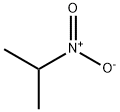
2-니트로프로판 속성
- 녹는점
- -93 °C
- 끓는 점
- 120 °C(lit.)
- 밀도
- 0.992 g/mL at 25 °C(lit.)
- 증기 밀도
- ~3 (vs air)
- 증기압
- ~13 mm Hg ( 20 °C)
- 굴절률
- n
20/D 1.394(lit.)
- 인화점
- 99 °F
- 저장 조건
- Flammables area
- 용해도
- H2O: 약간 용해됨
- 산도 계수 (pKa)
- pK1:7.675 (25°C)
- 물리적 상태
- 액체
- 색상
- 무색 내지 거의 무색
- 수용성
- 1.7g/100mL(20℃)
- 비열
- Cp(liquid): 1.91 J/(g·K), at 25℃
- Merck
- 14,6628
- BRN
- 1740684
- Henry's Law Constant
- 8.92 at 20.00 °C, 15.3 at 30.00 °C, 24.4 at 40.00 °C, 36.9 at 50.00 °C (inert gas stripping, Bene and Dohnal, 1999)
- 노출 한도
- ACGIH TLV-TWA:10 ppm (36 mg/m3)
OSHA PEL-TWA:25 ppm (90 mg/m³)
NIOSH IDLH:100 ppm
- Dielectric constant
- 25.5
- 안정성
- 안정적인. 강산화제, 강염기, 구리와 호환되지 않습니다.
- InChI
- 1S/C3H7NO2/c1-3(2)4(5)6/h3H,1-2H3
- InChIKey
- FGLBSLMDCBOPQK-UHFFFAOYSA-N
- SMILES
- CC(C)[N+]([O-])=O
- LogP
- 1.35 at 20℃
- CAS 데이터베이스
- 79-46-9(CAS DataBase Reference)
- IARC
- 2B (Vol. 29, Sup 7, 71) 1999
안전
- 위험 및 안전 성명
- 위험 및 사전주의 사항 (GHS)
| 위험품 표기 | T | ||
|---|---|---|---|
| 위험 카페고리 넘버 | 45-10-20/22-68-52/53 | ||
| 안전지침서 | 53-45-61-36/37 | ||
| 유엔번호(UN No.) | UN 2608 3/PG 3 | ||
| WGK 독일 | 3 | ||
| RTECS 번호 | TZ5250000 | ||
| 자연 발화 온도 | 802 °F | ||
| TSCA | TSCA listed | ||
| 위험 등급 | 3.2 | ||
| 포장분류 | III | ||
| HS 번호 | 29042000 | ||
| 스토리지 클래스 | 3 - Flammable liquids | ||
| Hazard Classifications | Acute Tox. 3 Inhalation Acute Tox. 4 Oral Aquatic Chronic 3 Carc. 1B Flam. Liq. 3 Muta. 2 |
||
| 유해 물질 데이터 | 79-46-9(Hazardous Substances Data) | ||
| 독성 | Acute oral LD50 for rats 720 mg/kg (quoted, RTECS, 1985). | ||
| IDLA | 100 ppm | ||
| 기존화학 물질 | KE-26027 |


2-니트로프로판 C화학적 특성, 용도, 생산
개요
2-Nitropropane, also known as dimethylnitromethane or isonitropropane, is a colourless, oily liquid with a mild and sweet odour. This flammable compound is soluble in water and various organic solvents, including chloroform. Its vapors can form an explosive mixture when combined with air. 2-Nitropropane serves as a co-solvent in paint formulations, enhancing pigment wetting, optimizing flow properties, and facilitating electrostatic processing. Additionally, it contributes to a shorter paint drying time.화학적 성질
2-Nitropropane, also known as 2-NP, is an aliphatic nitro compound that appears as a colourless, flammable liquid with a mild fruity odour. It can dissolve in water (1.7 mL/100 mL at 20C) and is miscible with organic solvents.Like other nitroalkanes, 2-nitropropane exists in equilibrium with 2-propane nitronic acid (HSDB 1988). A 0.01 M aqueous solution of 2-NP has a pH of 6.2. When reacted with inorganic bases and amines, 2-nitropropane forms salts that are flammable when dry. It is sensitive to detonation when combined with oxidizers, and a mixture of 2-nitropropane and ammonium nitrate serves as a commercial explosive.
물리적 성질
Colorless, oily liquid with a mild, fruity odor. 2-Nitropropane was detected in two studies at concentrations of 3.1 and 5.2 ppmv (Crawford et al., 1984).용도
2-Nitropropane is primarily used as a solvent for organic compounds and coatings; with vinyl resins, epoxy paints, nitrocellulose, and chlorinated rubber; in printing inks, adhesives, and printing as flexographic inks; maintenance with traffic markings on roads and highways; shipbuilding; and general maintenance. It also has limited use as a paint and varnish remover. 2-Nitropropane is also used as a solvent in food processing industries for fractionation of a partially saturated vegetable oil.제조 방법
The synthesis of 2-nitropropane can be accomplished directly by nitration of 2-halopropanes with sodium nitrite. With 2-iodopropane, the reaction is carried out in dry DMF in the presence of urea. For the slower reacting 2-bromopropane, a longer reaction time and the presence of phloroglucinol as a nitrite ester scavenger is required.Like 1-nitropropane, 2-nitropropane is also produced by vapor-phase nitration of propane with nitric acid at elevated temperature and pressure (Baker and Bollmeier 1978).
정의
ChEBI: 2-nitropropane is a secondary nitroalkane that is propane in which a hydrogen at position 2 has been replaced by a nitro group. Mainly used as a solvent (b.p. 120℃). It has a role as a hepatotoxic agent, a carcinogenic agent, a polar aprotic solvent and a xenobiotic.일반 설명
2-Nitropropane is a clear, colorless liquid with a pleasant odor that is soluble in many organic solvents, including chloroform. Its vapors may form an explosive mixture with air.공기와 물의 반응
Highly flammable.반응 프로필
2-Nitropropane is sensitive to heat. Can react with amines/heavy metal oxides, strong acids, strong alkalis, and chlorosulfonic acid. . The heat of adsorption of 2-Nitropropane on carbon, such as that found in cartridge respirators, is extremely high. Metal oxide catalysts, such as copper oxide or manganese oxide, can initiate ignition, therefore carbon respirators should not be used in environments that have a high vapor concentration of 2-Nitropropane.건강위험
2-Nitropropane is a lung irritant. The acute effects of exposure to 2-nitropropane at 20-45 p.p.m. on workmen were anorexia, nausea, vomiting, diarrhea and severe occipital headache. Liver effects have been observed in animals chronically exposed to 2-nitropropane by inhalation.Carcinogenicity
2-Nitropropane was classified by the International Agency for Research on Cancer (IARC) as Group 2B, possibly carcinogenic to humans, based on animal studies linking exposure to liver cancer in rats.The carcinogenicity of 2-nitropropane in humans was not evaluated due to the lack of adequate epidemiological data.환경귀착
Photolytic. Anticipated products from the reaction of 2-nitropropane with ozone or OH radicals in the atmosphere are formaldehyde and acetaldehyde (Cupitt, 1980).운송 방법
UN2608 Nitropropanes, Hazard Class: 3; Labels: 3-Flammable liquid.Purification Methods
Purify it as for nitromethane. [Beilstein 1 IV 230.]비 호환성
1-Nitropropane, a nitroparaffin compound, forms explosive mixture with air. Contact with heavy metal oxides may cause decomposition. Mixtures with hydrocarbons are extremely flammable. Attacks some plastics, rubber and coatings. May explode on heating. Violent reaction with strong bases; strong acids and metal oxides. Shock-sensitive compounds are formed with acids, amines, inorganic bases and heavy metal oxides. Incompatible with strong oxidizers, combustible materials. 2-Nitropropane reacts with activated carbon causing decomposition. This reaction may occur in activated carbon respirator filters.폐기물 처리
Incineration: large quantities of material may require nitrogen oxide removal by catalytic or scrubbing processes. Dilute with pure kerosene and burn with care as it is potentially explosive. Consult with environmental regulatory agencies for guidance on acceptable disposal practices. Generators of waste containing this contaminant (≥100 kg/mo) must conform with EPA regulations governing storage, transportation, treatment, and waste disposal.2-니트로프로판 준비 용품 및 원자재
원자재
준비 용품
2-니트로프로판 공급 업체
글로벌( 222)공급 업체
| 공급자 | 전화 | 이메일 | 국가 | 제품 수 | 이점 |
|---|---|---|---|---|---|
| LEEDS CHEMICAL(SHANGHAI) CO.,LTD | 021-57620989 13601674297 |
2482818028@qq.com | China | 96 | 58 |
| Shanghai Bojing Chemical Co., Ltd | 021-37199966 13681836088 |
bj@bj-chem.com | China | 463 | 58 |
| Shanghai Worldyang Chemical Co.,Ltd. | 021-56795766 |
sales@worldyachem.com | China | 9475 | 58 |
| Dingzhou Risun New Materials Co.,Ltd. | 0312-5538378 15933157875 |
xysales@risun.com | China | 6 | 58 |
| Hubei Jiuchang New Material Technology Co., Ltd | 13407109540 |
15216757546@163.com | China | 242 | 58 |
| SelectLab Chemicals GmbH | +49-(0)2383-919350 |
info@selectlab.de | Germany | 393 | 55 |
| TCI (Shanghai) Development Co., Ltd. | 021-67121386 |
Sales-CN@TCIchemicals.com | China | 24512 | 81 |
| Energy Chemical | 400-0056266 18918157536; |
sales8178@energy-chemical.com | China | 45000 | 61 |
| JinYan Chemicals(ShangHai) Co.,Ltd. | 13817811078 |
sales@jingyan-chemical.com | China | 9963 | 60 |
| Shanghai Hanhong Scientific Co.,Ltd. | 021-54306202 13764082696 |
info@hanhongsci.com | China | 42917 | 64 |